What is inserted twice?
The tray carrying the initial impression.

A two-stage putty-wash impression is made in two separate steps. A firmer initial impression serves as a carrier. It is reseated with space for a low-viscosity material that records fine contours.
For training & practice ↓
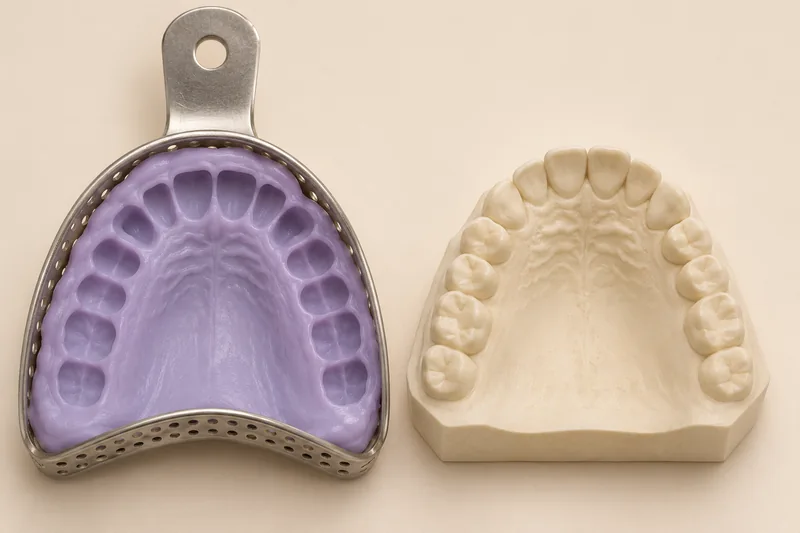
A dimensionally stable material in a tray provides the first record. This initial impression is retained for the second step.
Space is provided for the low-viscosity material. The first impression needs to reseat in the intended position in a controlled way.
The thin wash refines the negative mould. The team checks the required contours, especially preparation margins, for incomplete detail or defects.
The tray carrying the initial impression.
When the wash contacts the surfaces during the second seating.
The clinician assesses whether a new record is needed.
Three steps. No audio.
Each scene can also be selected manually.

Silent film with English on-screen text and simplified teaching images.
In the two-stage technique the initial material sets before the second impression. A simultaneous dual-viscosity technique uses both materials together.
The two steps may be planned from the start. The second material adds detail to the initial shape.
Controlled space accommodates a suitable thickness of wash. Too little space can interfere with complete reseating.
There are also simultaneous methods and digital scanning. Access, margin location and the planned restoration help determine the approach.
A question to bring along
Does the impression capture the entire margin of my prepared tooth?
For a planned crown, the team can explain which records the restoration requires.
Choose a dental appointmentAppointment selection at DoctolibLaboratory studies compare techniques under controlled conditions. A clinical impression is assessed at the actual preparation margin.
Editorial research: . General information, not an individual diagnosis or treatment recommendation. Teaching illustrations are simplified and do not depict a patient case.
If you turn this on, this website stores which guides you open, separately from advertising preferences. The markers expire after a fixed 30-day period from activation. The list is not sent to us by this feature. You can turn it off here and delete the markers.
Other people using the same browser profile can also see the markers. German and English versions share one marker. Expired entries are removed the next time you open a page with this feature; deleting browser data may remove them earlier. “Viewed” means opened, not read or completed.