What holds the analogue?
For example, a stone cast or a printed model designed for it.

A laboratory implant analogue replicates the position and connection of an implant or abutment in a working cast. It gives the technician a matching connection on which to build or check the restoration.
For training & practice ↓
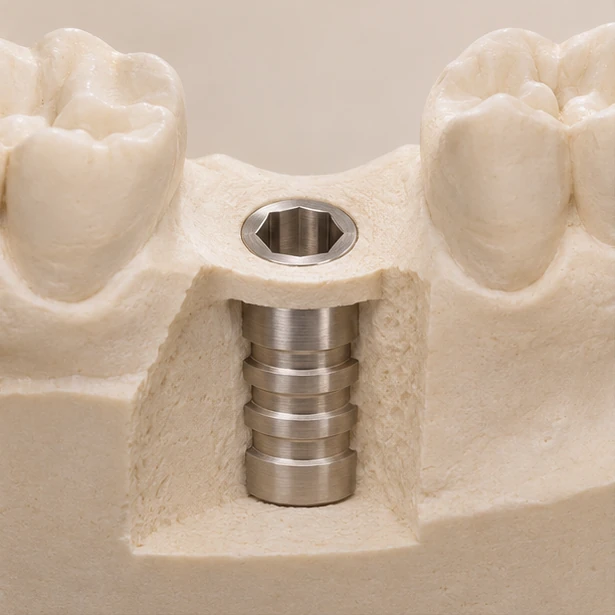
The laboratory fixes the analogue in the working cast. Its connection should reproduce the position and orientation recorded in the mouth.
In a conventional impression, an impression coping transfers the recorded position to the analogue. A digital cast can include a matching socket based on the recorded data.
The cast connection accepts an abutment or framework for checking. A positioning error in the cast can appear later as a misfit on the real implant.
For example, a stone cast or a printed model designed for it.
A scan body makes the position identifiable in a digital scan.
Positioning or fixation errors are possible and can be investigated when a discrepancy occurs.
Three steps. No audio.
Each scene can also be selected manually.

Silent film with English on-screen text and simplified teaching images.
It stays in the working cast. Your mouth contains the actual implant or an abutment attached to it.
The height, shape and orientation must represent the clinical connection. Components that look similar can still have different interfaces.
It allows much of the work to take place outside your mouth. If the clinical fit differs, the team can check the record, cast and components before completing the restoration.
A question to bring along
How do you check that the cast matches the situation in my mouth?
At a consultation, you can ask to see which components stay in the laboratory and which are used in the mouth.
Choose a dental appointmentAppointment selection at DoctolibPositional errors can arise during recording or cast production.
Editorial research: . General information, not an individual diagnosis or treatment recommendation. Teaching illustrations are simplified and do not depict a patient case.
If you turn this on, this website stores which guides you open, separately from advertising preferences. The markers expire after a fixed 30-day period from activation. The list is not sent to us by this feature. You can turn it off here and delete the markers.
Other people using the same browser profile can also see the markers. German and English versions share one marker. Expired entries are removed the next time you open a page with this feature; deleting browser data may remove them earlier. “Viewed” means opened, not read or completed.