How long should I wear it?
Follow the instructions for your own operation.

A surgical wafer is a custom bite guide for jaw repositioning. Indentations for the teeth help the surgical team bring the upper and lower jaws into a planned relationship at a particular stage of the operation. Fixing the repositioned bone is a separate step.
For training & practice ↓
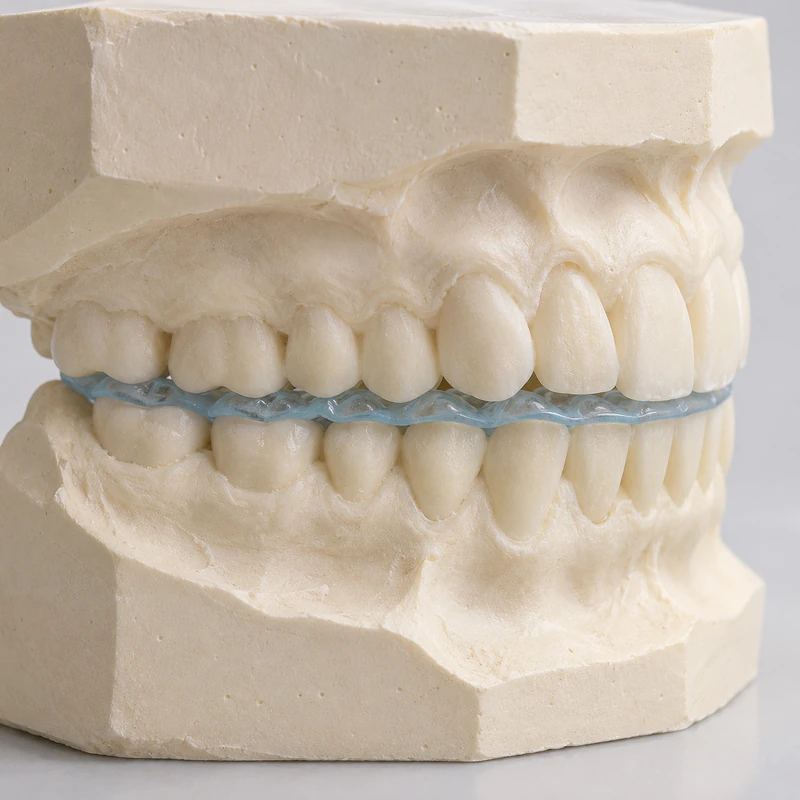
The wafer is made using dental casts or digital tooth records in the planned jaw relationship. Its shape must match the stage it will guide.
In double-jaw surgery an intermediate wafer may first guide one repositioned jaw against the other. A final wafer may then guide the intended relationship of both dental arches.
The guide helps transfer the plan. Depending on the procedure, plates or screws may be used to stabilise repositioned bone segments.
Follow the instructions for your own operation.
The chewing surfaces and incisal edges of the dental arches.
The plan, correct guide identification and seating on the teeth.
Three steps. No audio.
Each scene can also be selected manually.

Silent film with English on-screen text and simplified teaching images.
A guard for grinding serves a different purpose and does not represent a planned intermediate surgical position.
That depends on the surgical approach and the team's instructions. A wafer used only during surgery and one used temporarily afterwards serve different purposes.
Its indentations guide the teeth into a relationship. The surgical team must independently provide and check stability of the repositioned bone.
A randomised study compared conventional wafers, digital wafers and other digital guides. The two wafer groups did not differ significantly on the position measure studied. Accuracy depends on the whole transfer process.
A question to bring along
Which wafer will my team use at each stage, and what instructions apply after surgery?
Ask your surgical team about your own wafer, cleaning instructions and when to use it.
Choose a dental appointmentAppointment selection at DoctolibThe guide establishes a position. Fixation and bone healing require separate assessment.
Editorial research: . General information, not an individual diagnosis or treatment recommendation. Teaching illustrations are simplified and do not depict a patient case.
If you turn this on, this website stores which guides you open, separately from advertising preferences. The markers expire after a fixed 30-day period from activation. The list is not sent to us by this feature. You can turn it off here and delete the markers.
Other people using the same browser profile can also see the markers. German and English versions share one marker. Expired entries are removed the next time you open a page with this feature; deleting browser data may remove them earlier. “Viewed” means opened, not read or completed.