Does every defect need surgery?
Initial care addresses plaque and inflammation, followed by reassessment.

A periodontal bone defect is a local loss of the bone supporting a tooth. In a vertical defect the loss runs deeper along one side of a root than the surrounding bone crest. Its shape influences possible treatment.
For training & practice ↓
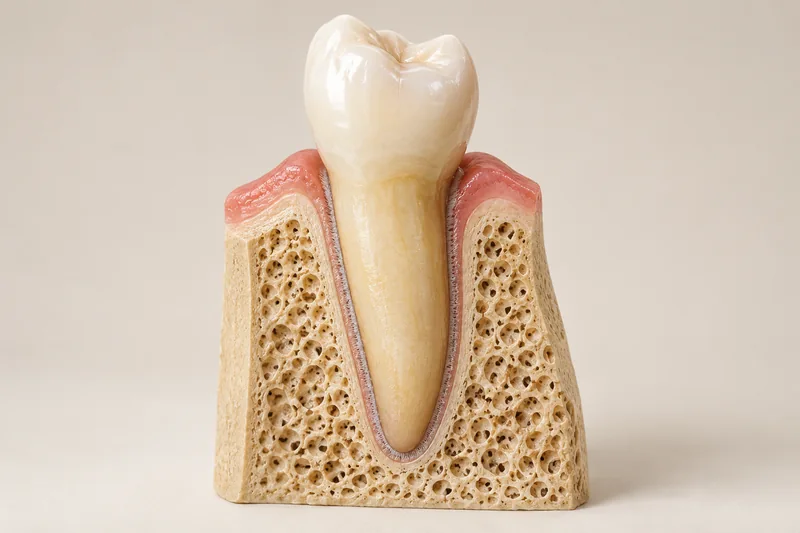
Supporting bone surrounds the root. A narrow ligament between root and bone cushions the tooth during chewing.
Uneven loss leaves an angle between the root and the remaining bone. Different numbers of bony walls may remain around the defect.
The clinician measures gum pockets and assesses the bone level on radiographs. A flat image gives limited information about the three-dimensional shape.
Initial care addresses plaque and inflammation, followed by reassessment.
The finding concerns its supporting bone.
The name alone cannot predict individual healing.
Three steps. No audio.
Each scene can also be selected manually.

Silent film with English on-screen text and simplified teaching images.
Decay affects hard tooth tissue. A periodontal bone defect is within the tissues supporting the tooth.
The EFP guideline recommends it for residual deep pockets with intrabony defects at least three millimetres deep. A clinician determines whether a particular tooth meets these criteria.
Gum may cover the site. Looking at the crown does not reveal the shape of the bone.
The team compares pocket depths, bleeding and, when appropriate, radiographs over time.
Ask the clinician to point out the affected root surface and the adjacent bone level on the radiograph.
Which pocket remains deep after initial treatment and how does this relate to the bone finding?
Periodontal follow-up helps plan the next steps for a known defect.
Choose an appointmentAppointment selection at DoctolibPocket depth and the depth of the bony defect are two different measurements.
Editorial research: . General information, not an individual diagnosis or treatment recommendation. Teaching illustrations are simplified and do not depict a patient case.
If you turn this on, this website stores which guides you open, separately from advertising preferences. The markers expire after a fixed 30-day period from activation. The list is not sent to us by this feature. You can turn it off here and delete the markers.
Other people using the same browser profile can also see the markers. German and English versions share one marker. Expired entries are removed the next time you open a page with this feature; deleting browser data may remove them earlier. “Viewed” means opened, not read or completed.