What is affected?
The amount or contour of tissue around an implant.

A peri-implant soft-tissue deficiency is an unfavourable amount or contour of mucosa around an implant. A recessed margin may reveal more of the crown or expose implant components. Assessment considers the tissue margin, implant and crown positions, and the papillae. A deficiency does not automatically mean peri-implantitis: inflammation and bone support need separate evaluation.
For training & practice ↓
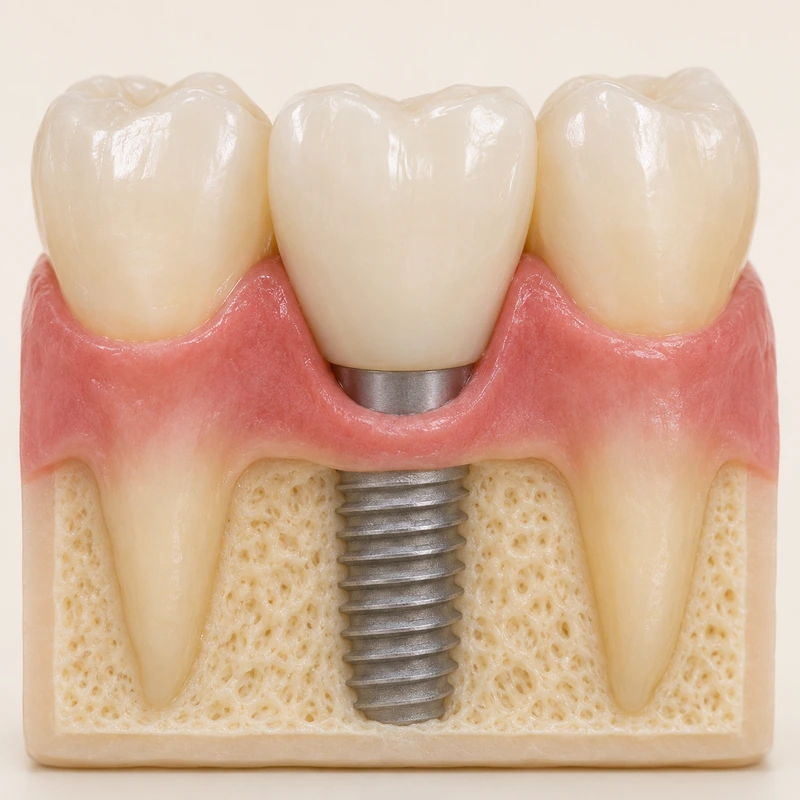
The mucosal margin may lie behind its intended contour or the tissue may lack volume. A photograph shows external shape but cannot alone establish inflammation or bone support.
Implant position, crown shape, soft tissue and neighbouring teeth influence appearance. The team also assesses inflammatory signs and bone before planning any correction.
Depending on the defect, options may include modifying the restoration, soft-tissue augmentation or combined treatment. Complete coverage cannot be promised. Cleaning and follow-up remain important.
The amount or contour of tissue around an implant.
No; inflammation is assessed separately.
No; anatomy limits what can be achieved.
Three steps. No audio.
Each scene can also be selected manually.

Silent educational film with German on-screen text and simplified teaching images. Not a patient case or a promised treatment outcome. The full English explanation is available as text.
A soft-tissue deficiency describes mucosal shape or volume. Peri-implantitis is an inflammatory disease with loss of supporting bone. They can coexist but are not synonyms.
No. Recession or thin tissue may be noticeable without this disease. Peri-implantitis requires assessment of inflammatory signs and corresponding bone loss.
No. An unfavourable implant or crown position may limit the options. Combined restorative and surgical planning is sometimes needed.
New recession, bleeding, swelling, pus, pain or mobility need prompt assessment. A change in contour or cleaning access also warrants review even without symptoms.
You can bring this question to your appointment:
How do implant position, crown shape and tissue volume contribute to my findings, and what result is realistic?
An individual assessment can clarify the findings and whether referral is needed.
Arrange an assessmentAppointment selection at DoctolibA soft-tissue deficiency describes mucosal shape or volume. Peri-implantitis is an inflammatory disease with loss of supporting bone. They can coexist but are not synonyms.
Editorial research: . General information, not an individual diagnosis or treatment recommendation. Teaching illustrations are simplified and do not depict a patient case.
If you turn this on, this website stores which guides you open, separately from advertising preferences. The markers expire after a fixed 30-day period from activation. The list is not sent to us by this feature. You can turn it off here and delete the markers.
Other people using the same browser profile can also see the markers. German and English versions share one marker. Expired entries are removed the next time you open a page with this feature; deleting browser data may remove them earlier. “Viewed” means opened, not read or completed.