What is a retentive site?
An area favouring plaque accumulation or difficult cleaning.

A plaque-retentive site is an area where deposits readily accumulate or are difficult to remove. Tooth position, calculus, an unfavourable filling margin or a difficult-to-access structure can impede cleaning.
For training & practice ↓
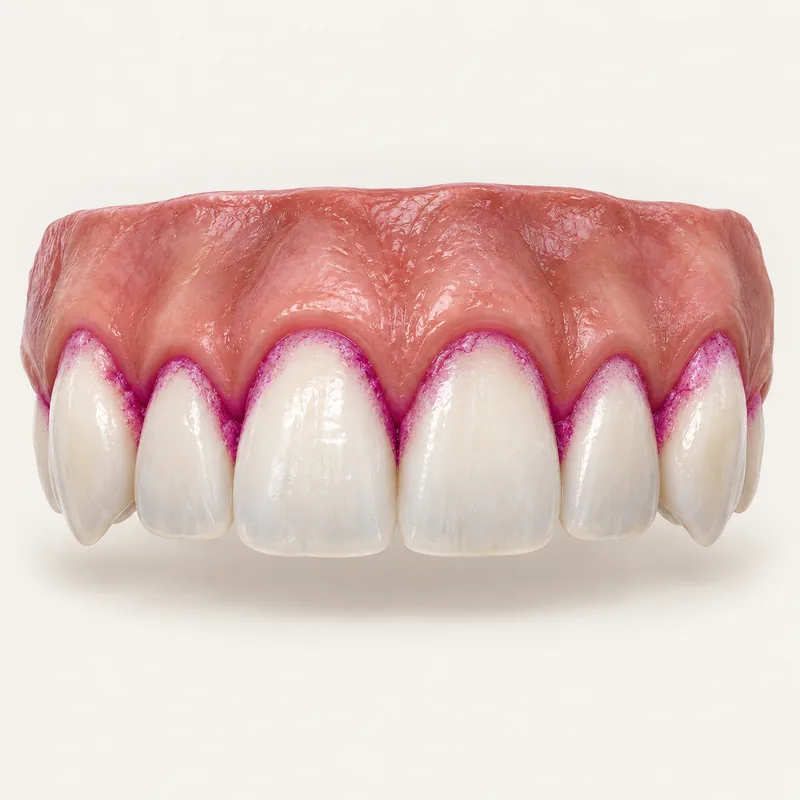
Tight or poorly visible areas are more easily missed during cleaning. An overhanging margin can also obstruct access. This is initially a local cleaning factor, not a complete diagnosis.
Examination establishes whether deposits, shape, position or handling contribute. This does not make every crown or appliance defective. What matters is whether surfaces can be kept effectively clean.
A suitable interdental brush, floss or adapted guidance may help. Obstructive hard deposits or problematic restoration margins may need professional treatment. Filing them yourself is not the answer.
An area favouring plaque accumulation or difficult cleaning.
No, natural tooth position and access can contribute.
Have the specific site and appropriate cleaning aids assessed.
Three steps. No audio.
Each scene can also be selected manually.

Silent educational film with German on-screen text and simplified teaching images. Not a patient case or a promised treatment outcome. The full English explanation is available as text.
The term describes a situation that favours plaque. It is not synonymous with caries or periodontitis.
No. It may encourage plaque; caries or gum disease requires a separate assessment.
Not automatically. Depending on findings, better cleaning, professional adjustment or another restoration may be appropriate.
Access, the surface or the cleaning aid may be unsuitable. A demonstration at that particular site helps clarify the problem.
Yes. It can encourage further plaque accumulation and make cleaning harder. Hardened deposits are removed professionally.
Recurrent bleeding, trapped food, odour, pain or catching floss are useful observations. They do not alone prove a specific cause.
You can bring this question to your appointment:
What is making this area difficult to clean, and can it be improved specifically?
Discuss which cleaning approach fits your findings.
Discuss dental careAppointment selection at DoctolibThe term describes a situation that favours plaque. It is not synonymous with caries or periodontitis.
Editorial research: . General information, not an individual diagnosis or treatment recommendation. Teaching illustrations are simplified and do not depict a patient case.
If you turn this on, this website stores which guides you open, separately from advertising preferences. The markers expire after a fixed 30-day period from activation. The list is not sent to us by this feature. You can turn it off here and delete the markers.
Other people using the same browser profile can also see the markers. German and English versions share one marker. Expired entries are removed the next time you open a page with this feature; deleting browser data may remove them earlier. “Viewed” means opened, not read or completed.