Is this an ordinary pressure sore?
A pressure sore can be a tender break in the lining. Denture-induced hyperplasia also involves a persistent excess of tissue. A fold itself can become sore if the flange keeps rubbing it.

Repeated rubbing or pressure from a denture flange can stimulate fibrous tissue growth. Smooth, elongated folds may form in the vestibule. The denture edge can sit in the groove between them. The condition is also called epulis fissuratum.
For training & practice ↓
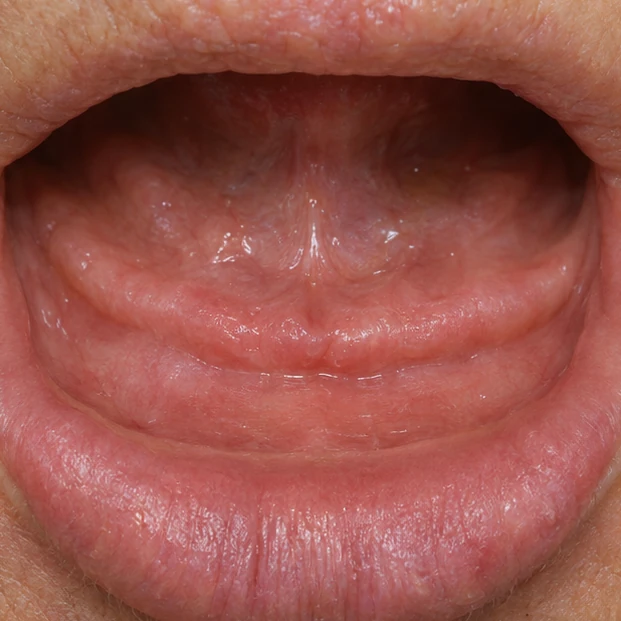
A persistent fold of tissue often runs parallel to the denture border.
The denture itself is needed to assess the fit. The removed model shows the base.
A pressure ulcer is a surface defect. A fold can coexist with it or develop a sore surface.
A persistent fold of tissue often runs parallel to the denture border.
The denture itself is needed to assess the fit. The removed model shows the base.
A pressure ulcer is a surface defect. A fold can coexist with it or develop a sore surface.
A pressure sore can be a tender break in the lining. Denture-induced hyperplasia also involves a persistent excess of tissue. A fold itself can become sore if the flange keeps rubbing it.
Whether it reduces depends in part on how long it has been there and how fibrous it is. The dentist checks the flange and fit. A pronounced persistent fold can be removed and examined microscopically.
Bring the denture that rests on the area. Comparing the flange with the tissue identifies where the pressure acts. Leave adjustments to the dental team.
Three steps. No audio.
Each scene can also be selected manually.

Silent film with English on-screen text and simplified teaching images.
The denture itself is needed to assess the fit. The removed model shows the base.
A pressure sore can be a tender break in the lining. Denture-induced hyperplasia also involves a persistent excess of tissue. A fold itself can become sore if the flange keeps rubbing it.
Whether it reduces depends in part on how long it has been there and how fibrous it is. The dentist checks the flange and fit. A pronounced persistent fold can be removed and examined microscopically.
Bring the denture that rests on the area. Comparing the flange with the tissue identifies where the pressure acts. Leave adjustments to the dental team.
A question to ask
Which part of my denture is irritating the lining?
Bring the denture for assessment of the tissue and fit.
Choose an appointmentAppointment selection at DoctolibCompare the course of the folds with the denture border. Correct ongoing mechanical irritation even if the excess tissue is excised.
Editorial research: . General information, not an individual diagnosis or treatment recommendation. Teaching illustrations are simplified and do not depict a patient case.
If you turn this on, this website stores which guides you open, separately from advertising preferences. The markers expire after a fixed 30-day period from activation. The list is not sent to us by this feature. You can turn it off here and delete the markers.
Other people using the same browser profile can also see the markers. German and English versions share one marker. Expired entries are removed the next time you open a page with this feature; deleting browser data may remove them earlier. “Viewed” means opened, not read or completed.