Denture saddles and frame
The pink saddle carries the replacement teeth. Metal links it to the rest of the denture.

The saddle is the part of the denture base immediately under the replacement teeth. Its lower surface lies against the gum-covered ridge at the gap. The visible part is often made of gum-coloured acrylic.
For training & practice ↓
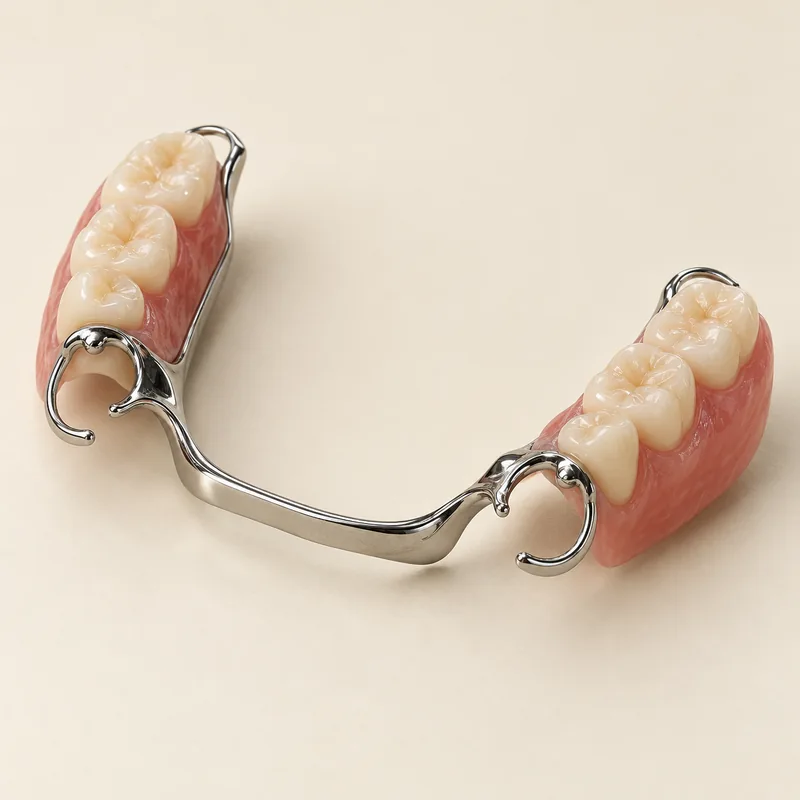
The pink saddle carries the replacement teeth. Metal links it to the rest of the denture.
A free-end saddle has no natural abutment tooth behind it.
The underside of the saddle rests on the lining over the ridge.
The pink saddle carries the replacement teeth. Metal links it to the rest of the denture.
A free-end saddle has no natural abutment tooth behind it.
The underside of the saddle rests on the lining over the ridge.
The pink saddle carries the replacement teeth. Metal links it to the rest of the denture.
A free-end saddle has no natural abutment tooth behind it.
The underside of the saddle rests on the lining over the ridge.
Three steps. No audio.
Each scene can also be selected manually.

Silent film with English on-screen text and simplified teaching images.
One gap may be restored with one saddle. A partial denture replacing teeth in several separate gaps may have several saddles joined by a framework.
One gap may be restored with one saddle. A partial denture replacing teeth in several separate gaps may have several saddles joined by a framework.
It replaces teeth at the back of a dental arch with no natural tooth behind the gap to support it. The lining over the ridge gives a little during chewing. Dentists take this movement into account when planning support.
The ridge can change shape after teeth are lost. Local pressure or a denture edge may also cause soreness. Show the spot to your dentist, who can check the fitting surface and your bite before adjusting the denture.
A question to ask
Can you show me where my saddle is supported and whether its fit has changed?
Choose an appointment to discuss your own tooth or restoration.
Choose an appointmentAppointment selection at DoctolibIdentify the part that carries the teeth, the tissues or teeth providing support, and the attachments giving retention. These roles may belong to different components.
Editorial research: . General information, not an individual diagnosis or treatment recommendation. Teaching illustrations are simplified and do not depict a patient case.
If you turn this on, this website stores which guides you open, separately from advertising preferences. The markers expire after a fixed 30-day period from activation. The list is not sent to us by this feature. You can turn it off here and delete the markers.
Other people using the same browser profile can also see the markers. German and English versions share one marker. Expired entries are removed the next time you open a page with this feature; deleting browser data may remove them earlier. “Viewed” means opened, not read or completed.