What is mounted for checking?
Your actual dentures are assessed on the instrument.

In a denture remount, casts carrying the dentures are mounted in an articulator again. A clinical remount uses a fresh record taken in the mouth to relate the jaws. This allows unwanted tooth contacts to be checked and adjusted outside the mouth.
For training & practice ↓
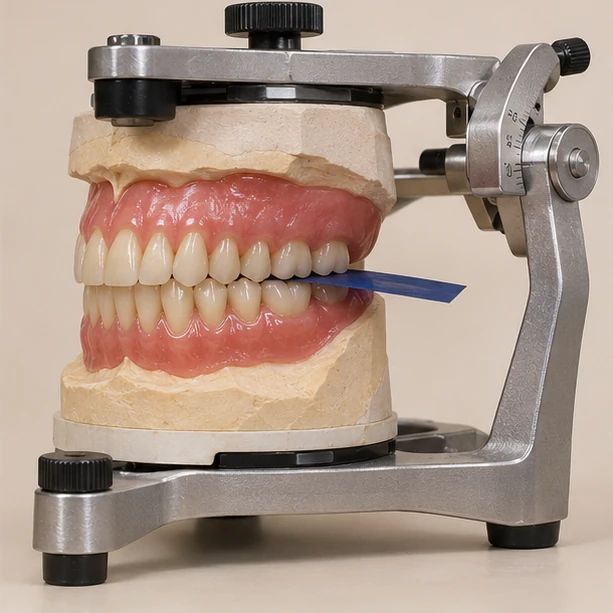
The dentures are mounted in the recorded relationship. Closure can then be examined repeatedly on the instrument.
Marking paper helps show which denture teeth touch. Seating and movement are considered too. A coloured mark alone does not determine the adjustment.
After adjustment, the clinician checks whether the denture remains stable and the resulting contacts match the actual bite.
Your actual dentures are assessed on the instrument.
Inadequate support beneath the base can also allow movement.
The relationship of the jaws in the patient at assessment.
Three steps. No audio.
Each scene can also be selected manually.

Silent film with English on-screen text and simplified teaching images.
A remount primarily checks the contacts between teeth. A reline adapts the tissue surface of the base.
An existing or recently completed set can be assessed at a remount. The condition of its bases and teeth and the oral examination determine whether replacement is also needed.
An early contact may lift a saddle. An ill-fitting base or changed supporting tissues can feel similar. Examination in the mouth helps distinguish these possibilities.
A clinical remount records the patient's jaw relationship again. A laboratory remount after processing can use the existing relationship between casts.
A question to bring along
Is the rocking coming from the base or from the tooth contacts?
Bring both dentures and, if useful, an older set for comparison when the bite feels wrong.
Choose a dental appointmentAppointment selection at DoctolibInstrument checks supplement the examination. How chewing feels is reassessed with the adjusted dentures in the mouth.
Editorial research: . General information, not an individual diagnosis or treatment recommendation. Teaching illustrations are simplified and do not depict a patient case.
If you turn this on, this website stores which guides you open, separately from advertising preferences. The markers expire after a fixed 30-day period from activation. The list is not sent to us by this feature. You can turn it off here and delete the markers.
Other people using the same browser profile can also see the markers. German and English versions share one marker. Expired entries are removed the next time you open a page with this feature; deleting browser data may remove them earlier. “Viewed” means opened, not read or completed.