Purpose?
Spatial transfer for work with casts.

A prosthetic facebow is a transfer instrument that records the spatial relationship of the upper dental arch to defined reference points on the head. This information helps position an upper-jaw cast in an articulator. The facebow does not move teeth and is not orthodontic headgear. It also does not replace separate assessment of the relationship between the upper and lower jaws.
For training & practice ↓
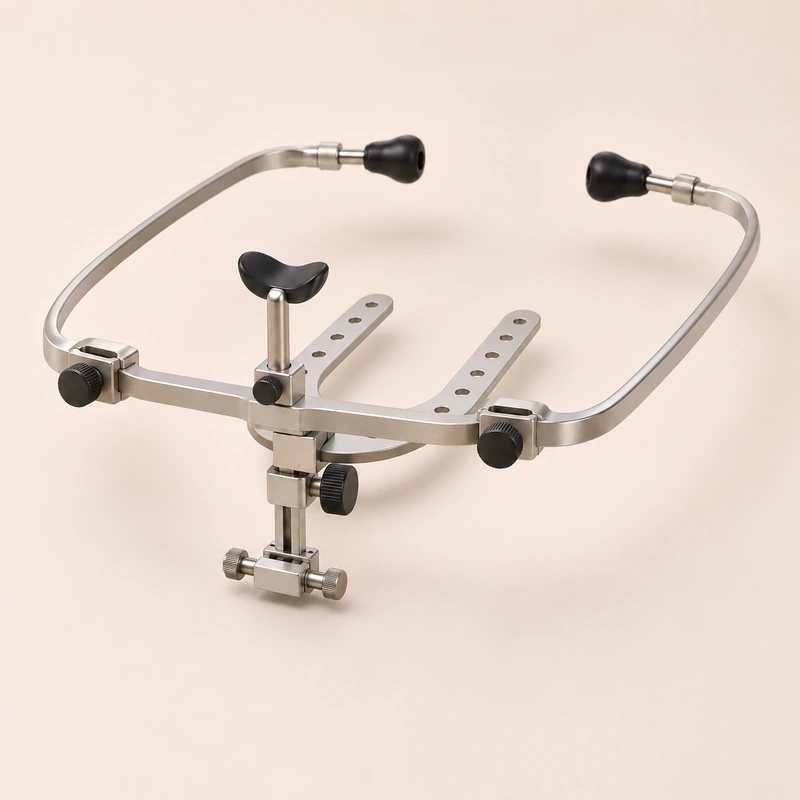
The bow links an upper-arch record to reference points on the head. This describes the position of the upper jaw for subsequent work with casts.
The recorded orientation can be transferred to an articulator. This differs from a bite record, which captures the relationship between the two jaws.
Whether a facebow transfer adds useful information depends on the restoration. Better outcomes have not been established for every application.
Spatial transfer for work with casts.
No.
No; that captures a different relationship.
Three steps. No audio.
Each scene can also be selected manually.

Silent educational film with German on-screen text and simplified teaching images. Not a patient case or a promised treatment outcome. The full English explanation is available as text.
A facebow transfers the orientation of the upper arch relative to reference points. A bite record documents a selected relationship between the upper and lower jaws.
No. Orthodontic headgear applies forces. A prosthetic facebow records and transfers a spatial relationship.
No. It orients the upper arch. Bite height and the relationship between the jaws require additional assessment and, when appropriate, records.
No. A spatial transfer is not a complete movement recording. Other examinations and recording methods would be required for that.
There is no universal answer. A randomized study of complete-denture remounting found no substantial overall advantage for a particular facebow transfer over average settings. That result cannot automatically be extended to every restoration.
No. Records, materials, fabrication, fit and clinical checks work together. The instrument alone establishes neither the cause of symptoms nor treatment success.
You can bring this question to your appointment:
What additional information should a facebow provide for my particular restoration?
A dental examination can clarify how this relates to your findings and treatment planning.
Discuss your dental findingsAppointment selection at DoctolibA facebow transfers the orientation of the upper arch relative to reference points. A bite record documents a selected relationship between the upper and lower jaws.
Editorial research: . General information, not an individual diagnosis or treatment recommendation. Teaching illustrations are simplified and do not depict a patient case.
If you turn this on, this website stores which guides you open, separately from advertising preferences. The markers expire after a fixed 30-day period from activation. The list is not sent to us by this feature. You can turn it off here and delete the markers.
Other people using the same browser profile can also see the markers. German and English versions share one marker. Expired entries are removed the next time you open a page with this feature; deleting browser data may remove them earlier. “Viewed” means opened, not read or completed.