Where does it arise?
From exposed pulp.

A pulp polyp is an inflammatory overgrowth arising from exposed dental pulp that is still vital. It may protrude into the open cavity of a badly damaged tooth. The clinical term is chronic hyperplastic pulpitis. A red tissue mass near a tooth is not automatically a pulp polyp and needs examination.
For training & practice ↓
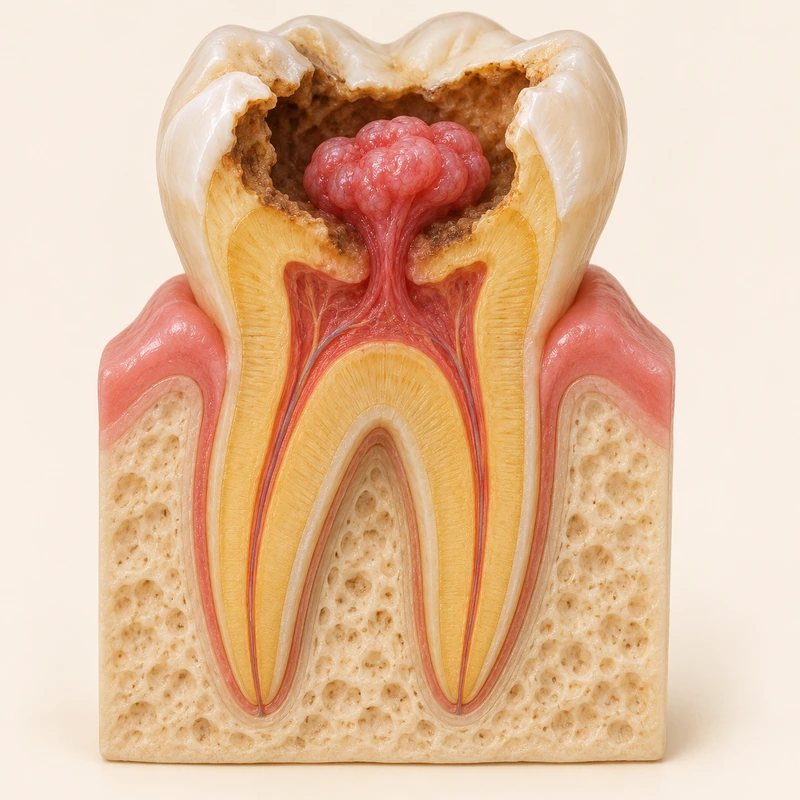
The tissue arises from exposed pulp rather than simply from the gum. Examination establishes its origin and distinguishes other tissue changes around a tooth cavity.
Inflamed pulp may cause few symptoms. Sensibility testing, radiographic findings and the remaining tooth structure contribute to treatment planning.
Depending on the findings, vital pulp treatment or root canal treatment may be possible. Removal is discussed if the tooth cannot be restored. Do not pull or cut the tissue yourself.
From exposed pulp.
No.
Pulp and root findings, together with restorability.
Three steps. No audio.
Each scene can also be selected manually.

Silent educational film with German on-screen text and simplified teaching images. Not a patient case or a promised treatment outcome. The full English explanation is available as text.
A pulp polyp originates in the pulp. Gum tissue can also grow into a cavity or develop a separate reactive lesion. Establishing the tissue’s origin is therefore important.
The term describes inflammatory growth of pulp tissue. It must not be assigned from appearance alone; other lesions need to be distinguished.
A pulp polyp arises from tissue that remains vital. This does not mean that all of the pulp is healthy or that treatment is unnecessary.
Not automatically. Diagnosis, root development, remaining tooth structure and restorability determine whether and how preservation is appropriate.
You can bring this question to your appointment:
Is the tissue confirmed to arise from the pulp, and which tooth-preserving option fits the findings?
An individual examination can clarify the findings and suitable next steps.
Arrange an assessmentAppointment selection at DoctolibA pulp polyp originates in the pulp. Gum tissue can also grow into a cavity or develop a separate reactive lesion. Establishing the tissue’s origin is therefore important.
Editorial research: . General information, not an individual diagnosis or treatment recommendation. Teaching illustrations are simplified and do not depict a patient case.
If you turn this on, this website stores which guides you open, separately from advertising preferences. The markers expire after a fixed 30-day period from activation. The list is not sent to us by this feature. You can turn it off here and delete the markers.
Other people using the same browser profile can also see the markers. German and English versions share one marker. Expired entries are removed the next time you open a page with this feature; deleting browser data may remove them earlier. “Viewed” means opened, not read or completed.