Which tissue does a pulp horn belong to?
The pulp in the crown of the tooth.

A pulp horn is a projection of the coronal pulp. In posterior teeth these projections extend towards the cusps, and in incisors towards the cutting edge. Their size and shape affect how much tooth structure separates the surface from the pulp.
For training & practice ↓
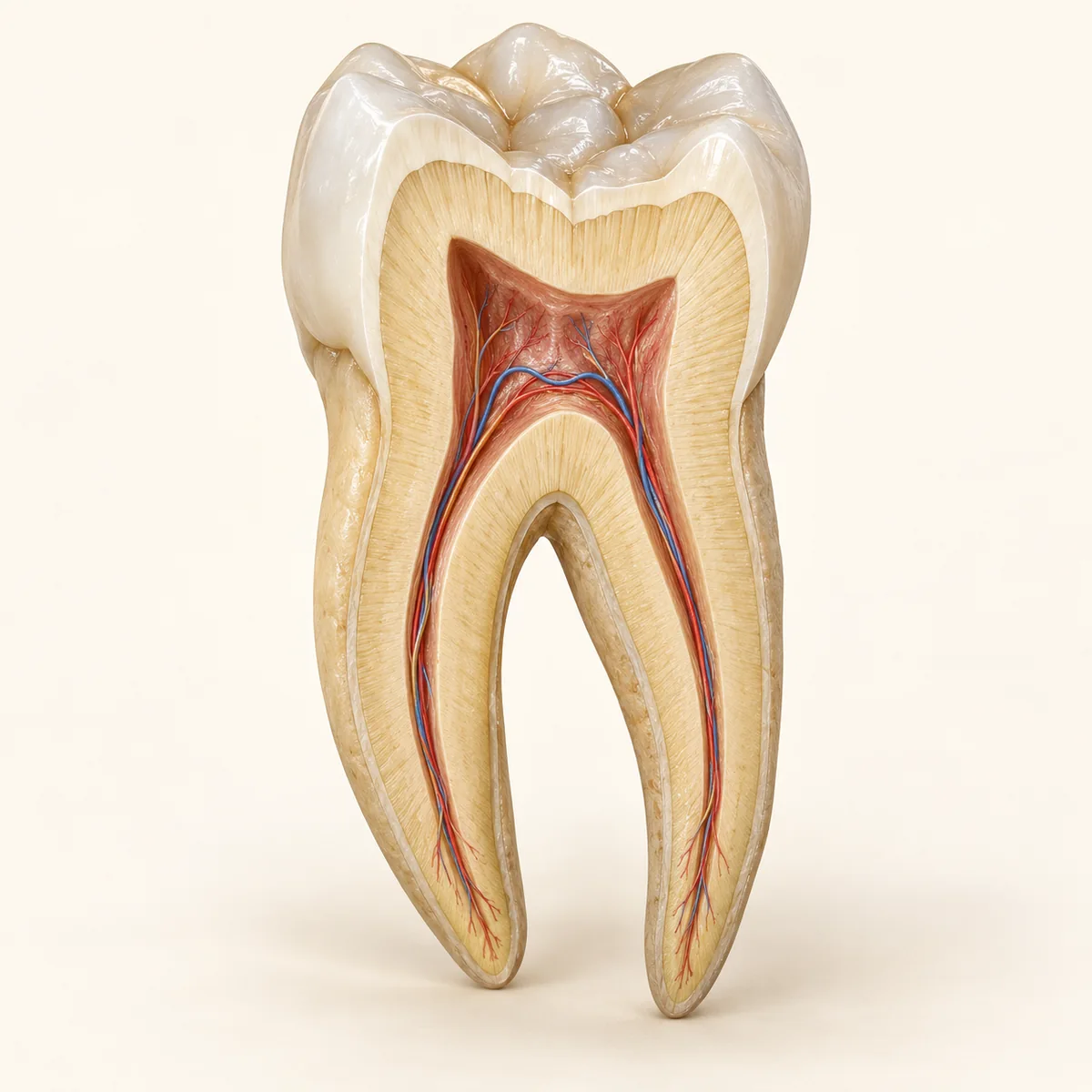
Inside the crown, the pulp occupies a chamber. Pulp horns project from its upper region towards the tooth surface.
In a molar the horns point towards the raised parts of the chewing surface. Protective hard tissue covers an intact pulp horn.
Continuing deposition of dentine often narrows the pulp space over time. The outline of a horn therefore differs between teeth.
The pulp in the crown of the tooth.
Towards a cusp on the chewing surface.
Continued deposition of dentine.
Three steps. No audio.
Each scene can also be selected manually.

Silent educational film with German on-screen text and simplified teaching images. Not a patient case or a promised treatment outcome. The full English explanation is available as text.
A horn projects within the crown. A root canal extends from the chamber into a root.
Inside the crown, the pulp occupies a chamber. Pulp horns project from its upper region towards the tooth surface.
In a molar the horns point towards the raised parts of the chewing surface. Protective hard tissue covers an intact pulp horn.
Continuing deposition of dentine often narrows the pulp space over time. The outline of a horn therefore differs between teeth.
In an intact tooth it lies inside. The outer cusp indicates only its approximate direction.
A horn projects within the crown. A root canal extends from the chamber into a root.
A question you could ask
How close is the defect in my tooth to a pulp horn?
When discussing a deep filling, ask what is known about the tissue between the defect and the pulp.
Discuss at a dental appointmentAppointment selection at DoctolibA horn projects within the crown. A root canal extends from the chamber into a root.
Editorial research: . General information, not an individual diagnosis or treatment recommendation. Teaching illustrations are simplified and do not depict a patient case.
If you turn this on, this website stores which guides you open, separately from advertising preferences. The markers expire after a fixed 30-day period from activation. The list is not sent to us by this feature. You can turn it off here and delete the markers.
Other people using the same browser profile can also see the markers. German and English versions share one marker. Expired entries are removed the next time you open a page with this feature; deleting browser data may remove them earlier. “Viewed” means opened, not read or completed.