Which teeth are especially relevant?
Selected immature permanent teeth with necrotic pulp.

Regenerative endodontics uses biologically based approaches for selected teeth with dead pulp, particularly when root development is incomplete. After infection control, treatment aims to create conditions for tissue ingrowth and development. Healing and further root development are possible goals; a completely new natural pulp cannot be promised.
For training & practice ↓
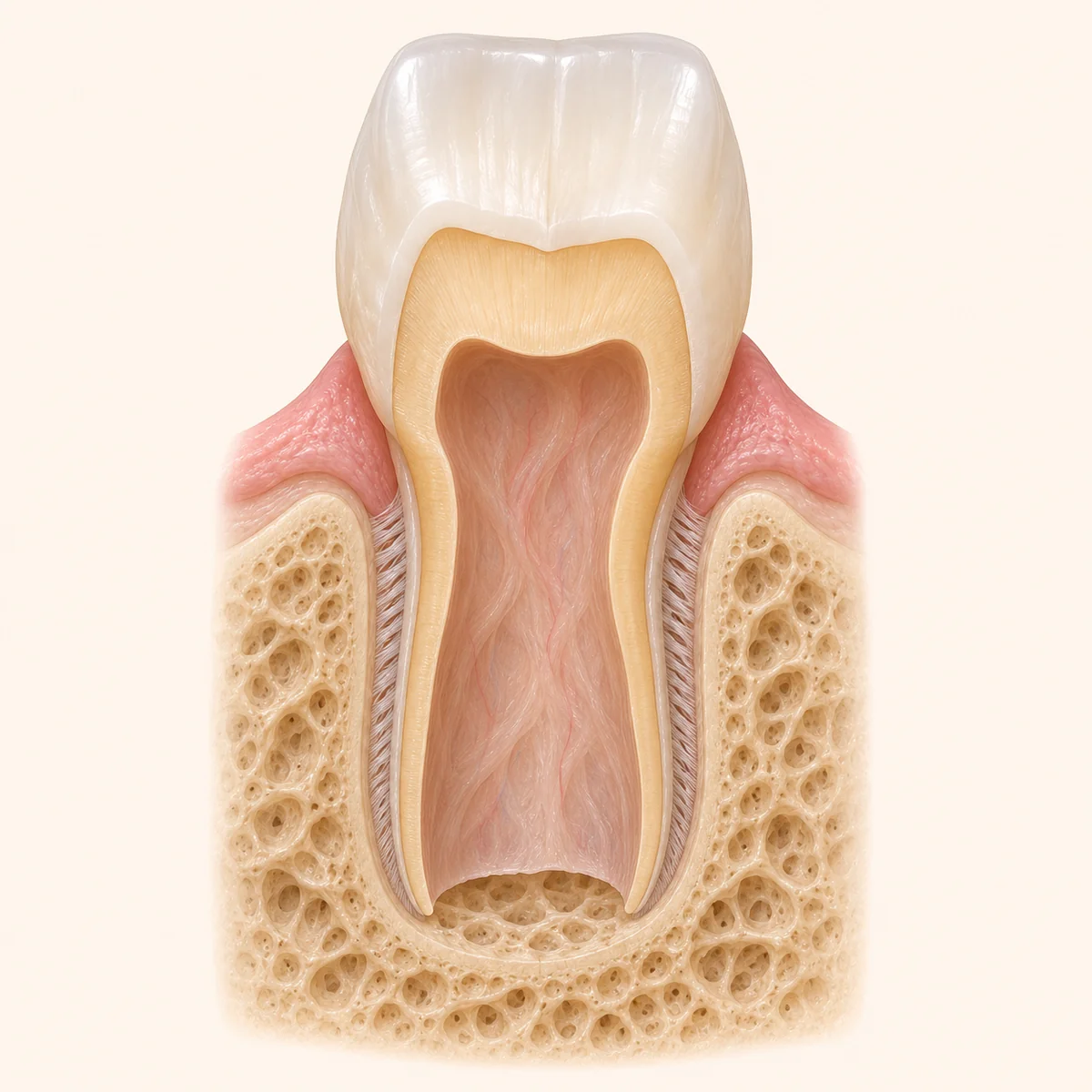
A young permanent tooth may have thin root walls and an open tip. If the pulp dies, this anatomy calls for adapted treatment planning.
Cleaning and disinfection aim to reduce the microbial burden while considering biological needs. This requires appropriate clinical experience.
A tissue scaffold and a sound coronal seal support the approach. Follow-up checks whether symptoms and inflammation resolve and whether root development continues.
Selected immature permanent teeth with necrotic pulp.
No. Progress is assessed clinically and radiographically.
No. The extent and course vary.
Three steps. No audio.
Each scene can also be selected manually.

Silent educational film with German on-screen text and simplified teaching images. Not a patient case or a promised treatment outcome. The full English explanation is available as text.
Apexification creates or establishes a barrier at an open root end. Regenerative approaches also aim for biological tissue development. The approaches are not interchangeable.
No. Clinical healing, additional hard tissue and a response to sensibility tests do not automatically prove complete recreation of the original pulp.
No. Root maturity, diagnosis, restorability and other requirements guide selection. Other endodontic approaches are more suitable in many situations.
Depending on the findings, apexification or an apical barrier may be considered. Goals, uncertainties and risks are discussed individually.
You can bring this question to your appointment:
What goals are realistic for this tooth, and how do regenerative treatment and an apical barrier differ?
An individual examination can clarify the findings and suitable next steps.
Arrange an assessmentAppointment selection at DoctolibApexification creates or establishes a barrier at an open root end. Regenerative approaches also aim for biological tissue development. The approaches are not interchangeable.
Editorial research: . General information, not an individual diagnosis or treatment recommendation. Teaching illustrations are simplified and do not depict a patient case.
If you turn this on, this website stores which guides you open, separately from advertising preferences. The markers expire after a fixed 30-day period from activation. The list is not sent to us by this feature. You can turn it off here and delete the markers.
Other people using the same browser profile can also see the markers. German and English versions share one marker. Expired entries are removed the next time you open a page with this feature; deleting browser data may remove them earlier. “Viewed” means opened, not read or completed.