Upper or lower teeth?
The classic description concerns the lower arch.

The curve of Spee describes the curvature of the lower dental arch in side view. In the classical description, its dental portion starts at the lower canine cusp and follows the cheek-side cusps of the premolars and molars. Its depth is considered when assessing the bite.
For training & practice ↓
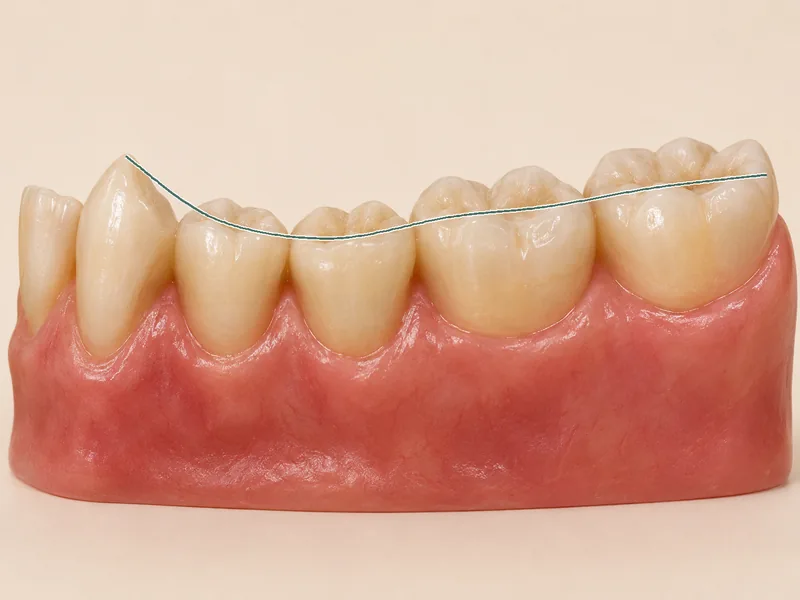
A fine line starts at the lower canine cusp and follows the outer cusps of the premolars and molars. The illustration shows the dental portion of the classical curve of Spee.
The curve is assessed together with incisor overlap, tooth positions and jaw relationships. A line alone is not a diagnosis.
Whether a change is appropriate depends on the complete findings. A flattened line in an illustration is not a treatment target for everyone.
The classic description concerns the lower arch.
Initially, it is an anatomical description.
Its depth varies.
Three steps. No audio.
Each scene can also be selected manually.

Silent educational film with German on-screen text and simplified teaching images. Not a patient case or a promised treatment outcome. The full English explanation is available as text.
Dental arch usually refers to the arrangement seen from above. The curve of Spee describes curvature in side view.
Curvature of the lower dental arch is an anatomical description. Its functional or treatment significance needs individual assessment.
No. A deep bite concerns vertical overlap of the lower incisors by the upper incisors. The curve of Spee describes the side-view profile of lower chewing surfaces; the findings can be related.
No. Planned tooth positions must fit function and the other findings. There is no single line that serves as a target for everybody.
You can bring this question to your appointment:
What role does the curve of Spee play in my bite?
An examination can clarify the finding and any need for referral.
Arrange an assessmentAppointment selection at DoctolibThe dental arch usually describes the arrangement seen from above. The curve of Spee is viewed from the side. The curve of Wilson describes the transverse curvature of the chewing surfaces.
Editorial research: . General information, not an individual diagnosis or treatment recommendation. Teaching illustrations are simplified and do not depict a patient case.