What helps decide?
Symptoms and the response of the pulp.

Deep caries extends far into the dentine beneath the enamel, close to the pulp. Treatment planning considers how much dentine separates the lesion from the pulp and how the pulp responds to tests.
For training & practice ↓
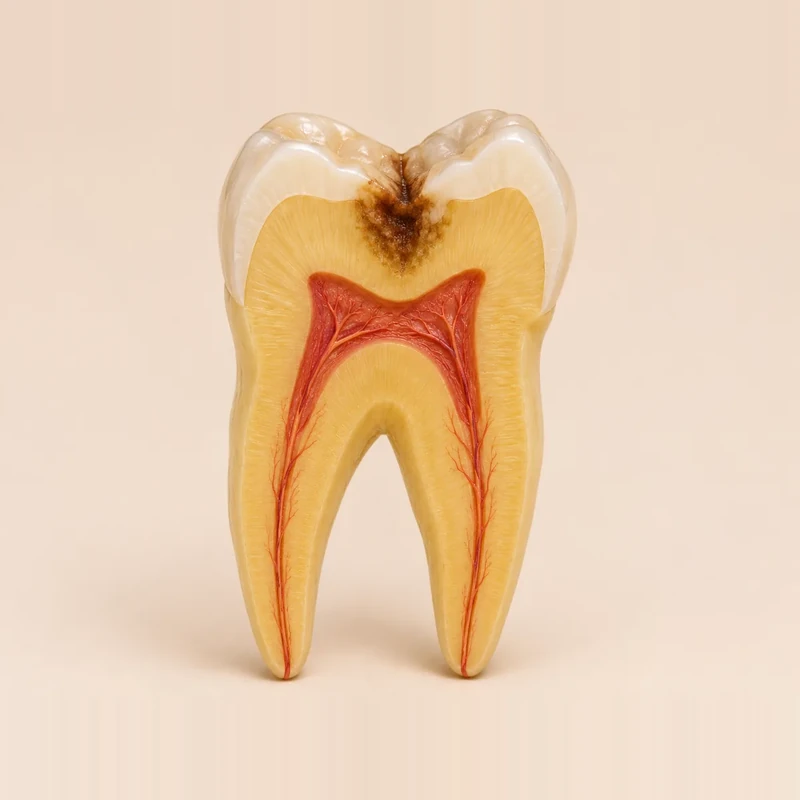
In section the defect approaches the pulp chamber. An X-ray shows that three-dimensional situation projected onto a flat image.
In suitable vital permanent teeth, softer dentine may be left close to the pulp. This reduces the risk of exposing it during excavation.
A durable seal needs sound supporting tissue at the margins. Reviews also check whether the tooth remains comfortable.
Symptoms and the response of the pulp.
To avoid unnecessarily exposing the pulp.
The lesion is close to the pulp.
Three steps. No audio.
Each scene can also be selected manually.

Silent film with English on-screen text and simplified teaching images.
With deep decay, a layer of dentine can still be seen separating the lesion from the pulp on imaging. With extremely deep decay this visible barrier is absent.
Pulp-preserving approaches may be possible if the pulp is vital and can heal. Spontaneous or persistent pain and clinical findings influence the decision.
Selective removal can leave softened dentine in the deepest part. This is a planned approach in selected teeth, with careful sealing of the margins.
Explain whether pain follows cold, lingers after it or starts on its own. Pain intensity alone cannot show exactly how deep the decay extends.
A question to bring along
Which findings suggest that my pulp can be preserved?
Discuss your symptoms alongside the examination before choosing treatment.
Choose an appointmentAppointment selection at DoctolibDeep describes the extent of decay. Pulp inflammation is assessed separately.
Editorial research: . General information, not an individual diagnosis or treatment recommendation. Teaching illustrations are simplified and do not depict a patient case.
If you turn this on, this website stores which guides you open, separately from advertising preferences. The markers expire after a fixed 30-day period from activation. The list is not sent to us by this feature. You can turn it off here and delete the markers.
Other people using the same browser profile can also see the markers. German and English versions share one marker. Expired entries are removed the next time you open a page with this feature; deleting browser data may remove them earlier. “Viewed” means opened, not read or completed.