What makes it different?
The same restoration connects a natural tooth to an implant.

In a tooth–implant-supported bridge, a natural tooth and an implant support the same fixed restoration. A pontic replaces the missing tooth between the supports. Their different mobility affects planning.
For training & practice ↓
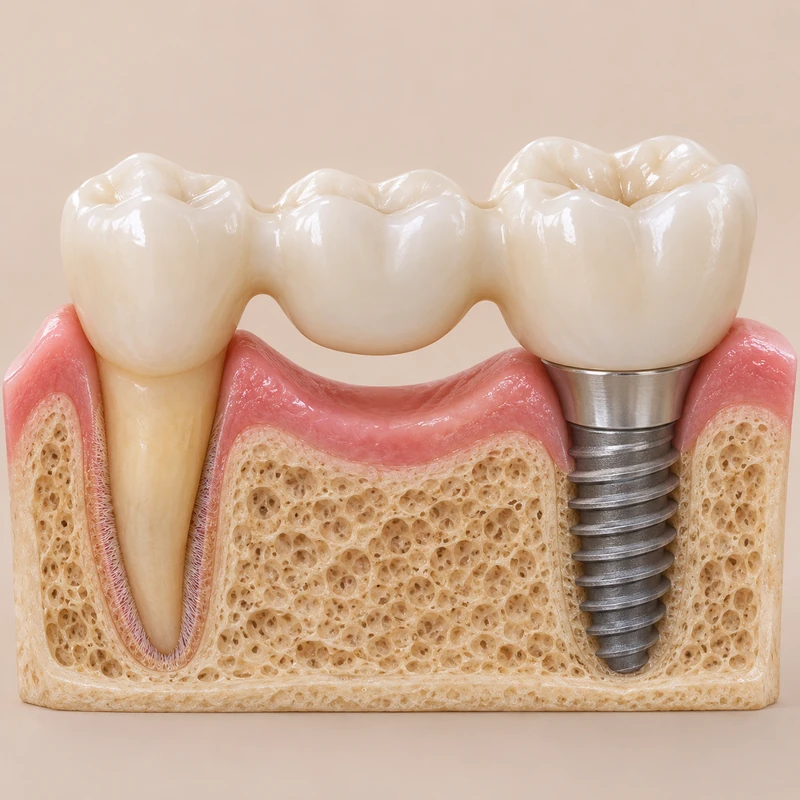
Fine ligament fibres suspend a natural root in its socket. The tooth can yield slightly under load.
An integrated implant is in direct contact with bone. The bridge joins two differently supported structures.
An entirely implant-supported bridge rests on implants. Space, tooth prognosis and cleaning access help guide the comparison.
The same restoration connects a natural tooth to an implant.
An adequate prognosis for the tooth structure, root and supporting tissues.
Both supports, their attachments and the tissue beneath the pontic.
Three steps. No audio.
Each scene can also be selected manually.

Silent film with English on-screen text and simplified teaching images.
A combined bridge uses at least one natural tooth. An implant-only bridge has no natural tooth abutment.
The natural tooth has a ligament between root and bone. An integrated implant has no equivalent ligament. This affects how forces are shared.
Its name alone tells you nothing about total cost. The starting situation, procedures needed, design and ongoing care all influence the individual decision.
Ask how to clean under the pontic and around the abutments. New movement, pain or bleeding should be checked.
Before planning a bridge
What is the long-term outlook for my natural abutment tooth, and what alternatives are there?
Discuss possible supports for a fixed restoration.
Choose an appointmentAppointment selection at DoctolibA natural tooth abutment remains susceptible to decay. Inflammation can affect the tissues surrounding an implant.
Editorial research: . General information, not an individual diagnosis or treatment recommendation. Teaching illustrations are simplified and do not depict a patient case.
If you turn this on, this website stores which guides you open, separately from advertising preferences. The markers expire after a fixed 30-day period from activation. The list is not sent to us by this feature. You can turn it off here and delete the markers.
Other people using the same browser profile can also see the markers. German and English versions share one marker. Expired entries are removed the next time you open a page with this feature; deleting browser data may remove them earlier. “Viewed” means opened, not read or completed.