Is ART always painless?
Hand instruments allow treatment without a rotary drill.

In atraumatic restorative treatment (ART), the clinician removes accessible soft decayed tissue with hand instruments and then usually seals the cavity using high-viscosity glass ionomer cement. The approach is suitable for selected lesions.
For training & practice ↓
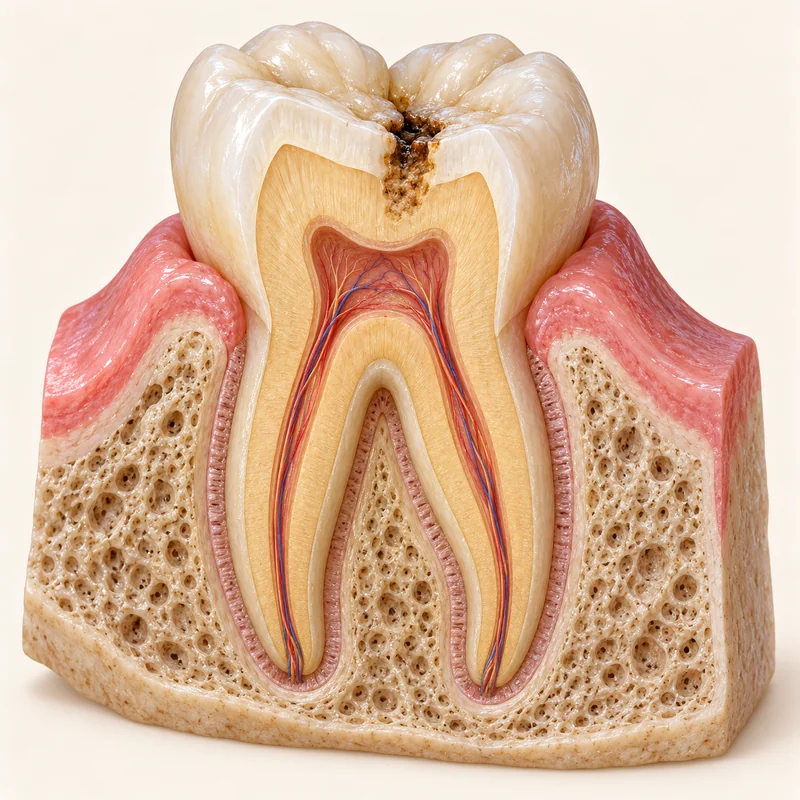
The cavity must be accessible with hand instruments and suitable for sealing. Signs of pulp disease or infection change the treatment plan.
An excavator is a small spoon-shaped instrument. It can remove softened tissue from the accessible lesion without opening it with a rotary bur.
A suitable restorative material seals the defect. Its durability depends partly on size, shape and the number of involved surfaces. The clinician checks the margins and integrity at follow-up.
Hand instruments allow treatment without a rotary drill.
Results are generally more favourable for single-surface restorations.
A relatively thick restorative material that adheres to tooth tissue.
Three steps. No audio.
Each scene can also be selected manually.

Silent educational film with German on-screen text and simplified teaching images. Not a patient case or a promised treatment outcome. The full English explanation is available as text.
ART uses hand instruments to remove accessible decayed tissue before placing a restoration. The Hall technique seals a suitable primary molar under a metal crown without caries removal.
Hand instruments allow treatment without a rotary drill. How the procedure feels depends on the tooth and the individual.
Results are generally more favourable for single-surface restorations. Larger defects and sites under heavy load may require other options.
A relatively thick restorative material that adheres to tooth tissue. The material alone does not mean a filling was placed by ART.
Single-surface ART restorations made with high-viscosity glass ionomer can last for years in suitable primary molars. Follow-up checks establish whether any further treatment is needed.
A question you could ask
Which surfaces are involved, and would ART withstand the load at this site?
Which surfaces are involved, and would ART withstand the load at this site?
Arrange a dental consultationAppointment selection at DoctolibART uses hand instruments to remove accessible decayed tissue before placing a restoration. The Hall technique seals a suitable primary molar under a metal crown without caries removal.
Editorial research: . General information, not an individual diagnosis or treatment recommendation. Teaching illustrations are simplified and do not depict a patient case.
If you turn this on, this website stores which guides you open, separately from advertising preferences. The markers expire after a fixed 30-day period from activation. The list is not sent to us by this feature. You can turn it off here and delete the markers.
Other people using the same browser profile can also see the markers. German and English versions share one marker. Expired entries are removed the next time you open a page with this feature; deleting browser data may remove them earlier. “Viewed” means opened, not read or completed.