What does the number refer to?
The tray's intended position within your series.

Movement staging divides the intended tooth correction into ordered steps. Each clear tray corresponds to a planned intermediate position. Some teeth can provide anchorage while others are being moved. The actual response still needs clinical assessment.
For training & practice ↓
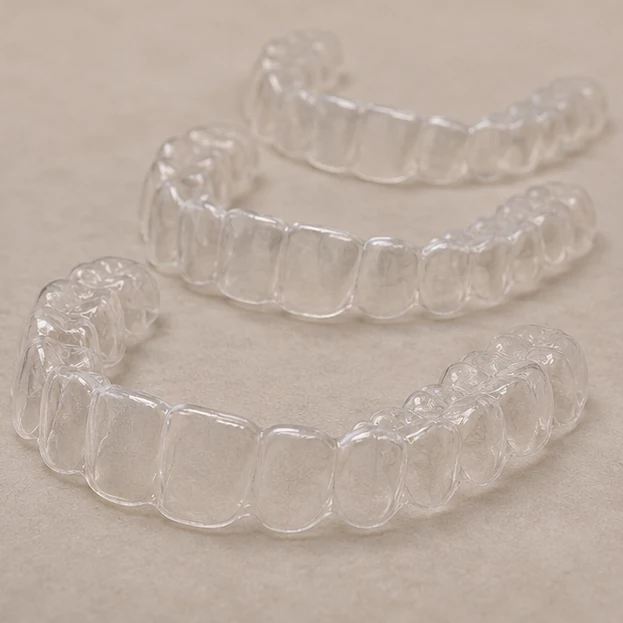
Each aligner corresponds to an intermediate stage. The sequence depends on the target, available space and anchorage needed.
One example is moving upper posterior teeth backwards in sequence. A tooth farther forward can follow once room has been created behind it.
A stage depends on the actual teeth being close enough to the intended positions. If the tray lifts noticeably, ask the treating team to check the next step.
The tray's intended position within your series.
Dividing and sequencing the planned movements over time.
Staging describes the plan. Tracking describes how the teeth follow it in the tray.
Three steps. No audio.
Each scene can also be selected manually.

Silent film with English on-screen text and simplified teaching images.
The interval is the time spent in one aligner. Staging describes which movements are planned and in what order.
Follow your agreed schedule. Ease of insertion does not reliably show whether all earlier movements took place. Ask how to proceed if you lose a tray.
It illustrates intended movements. Biological response, wear, anatomy and movement type affect how closely each stage is achieved. A revised plan may be needed if progress differs.
The increments depend on the tooth and objective. A small clinical study of molar movement combined staged movements, attachments and elastics. Its protocol is not a universal prescription.
A question to bring along
Which tooth is meant to move at my current stage, and how will progress be checked?
Contact your treating team before changing the sequence yourself if a tray is lost or clearly unseated.
Choose a dental appointmentAppointment selection at DoctolibThe planned sequence may differ from what the teeth actually achieve.
Editorial research: . General information, not an individual diagnosis or treatment recommendation. Teaching illustrations are simplified and do not depict a patient case.
If you turn this on, this website stores which guides you open, separately from advertising preferences. The markers expire after a fixed 30-day period from activation. The list is not sent to us by this feature. You can turn it off here and delete the markers.
Other people using the same browser profile can also see the markers. German and English versions share one marker. Expired entries are removed the next time you open a page with this feature; deleting browser data may remove them earlier. “Viewed” means opened, not read or completed.